
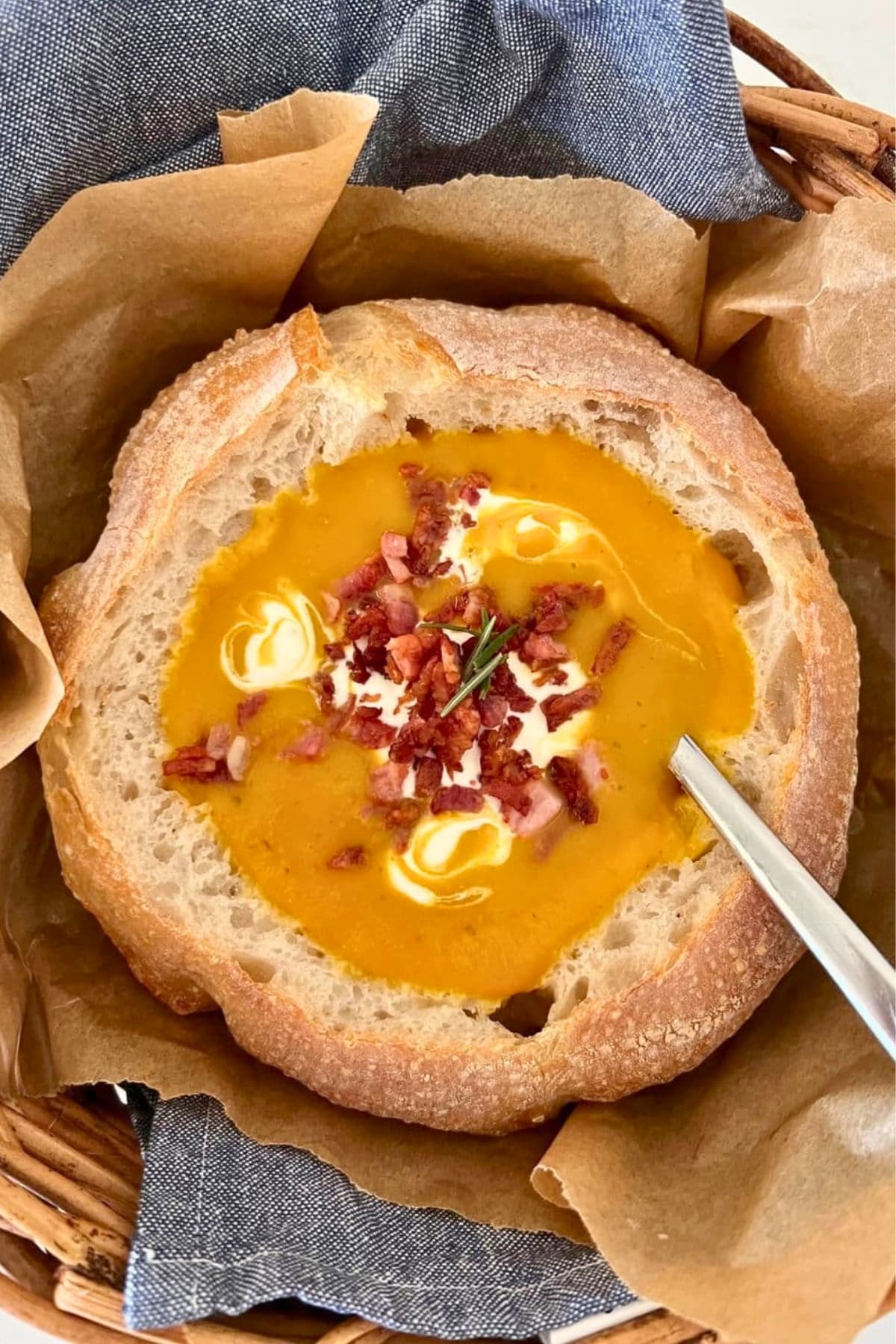
This sourdough bread bowl recipe is a fun way to serve soups, stews, chowders and dips! You can make as many sourdough bread bowls as you need by multiplying the recipe, which means you can make just two, or enough to feed a crowd! These round sourdough bread bowls feature a robust golden brown crust that’s strong enough to hold hot soup.
This post contains affiliate links. Please see our disclosure policy.
Why You’ll Love This Recipe!
- Fun Way To Serve Soup – Your family and friends will love homemade sourdough bread bowls – they’re just so much fun! But you don’t just have to serve soup, you can use them for stews, chowders and dips too!
- Perfection Not Necessary – I think the best thing about making sourdough bread bowls is that they don’t have to be perfect! Because you are cutting the top and middle out of the loaves, you don’t have to score them perfectly (that bit will be cut off and eaten with the soup!). And remember, the more craggly, crunchy bits … the better!
- Tried and Tested Recipe – These sourdough soup bowls have been created from my small batch sourdough bread recipe and has been made thousands of times, not just in my kitchen, but sourdough kitchens around the world!
Made these fairly early in my sourdough bread making journey and they turned out AMAZING. I split one bread bowl in half before proofing and this made 2 bowls at a perfect size for our kiddos. Thank you for the great step by step instructions! Definitely making these again very soon!
Ingredients
- Sourdough Starter – You’ll need to use an active sourdough starter to create these sourdough bread bowls.
- Water
- Bread Flour – It’s best to use bread flour because it has a much higher protein content than all-purpose flour and will give you a better rise and crust to your bread bowls. Read more about bread flour vs all purpose flour .
- Salt
How To Make Sourdough Bread Bowls
Making sourdough bread bowls is a fairly straight forward process, particularly if you have made a few loaves of sourdough bread before. This recipe is for 2 sourdough bread bowls. Depending on how comfortable you are in dividing dough after bulk fermentation, you could choose to make the whole batch as one dough, or divide it into two smaller bowls if you prefer – it’s up to you! To make more than 2 sourdough bread bowls, simply multiply the recipe (ie for 4 bread bowls, double the recipe). There’s a button on the recipe card below to help you do this easily. I highly recommend a good quality kitchen scale to ensure accuracy in this sourdough recipe.
Fermentolyse – Premixing The Dough
Weigh out your sourdough starter and water into a large mixing bowl. Mix the water and starter together briefly. Then add your flour and salt and mix whole lot together to form a shaggy dough. Cover your bowl with an elastic food cover and let it sit for around 1 hour. It’s ok if it’s a little bit longer, it’s not going to matter too much.
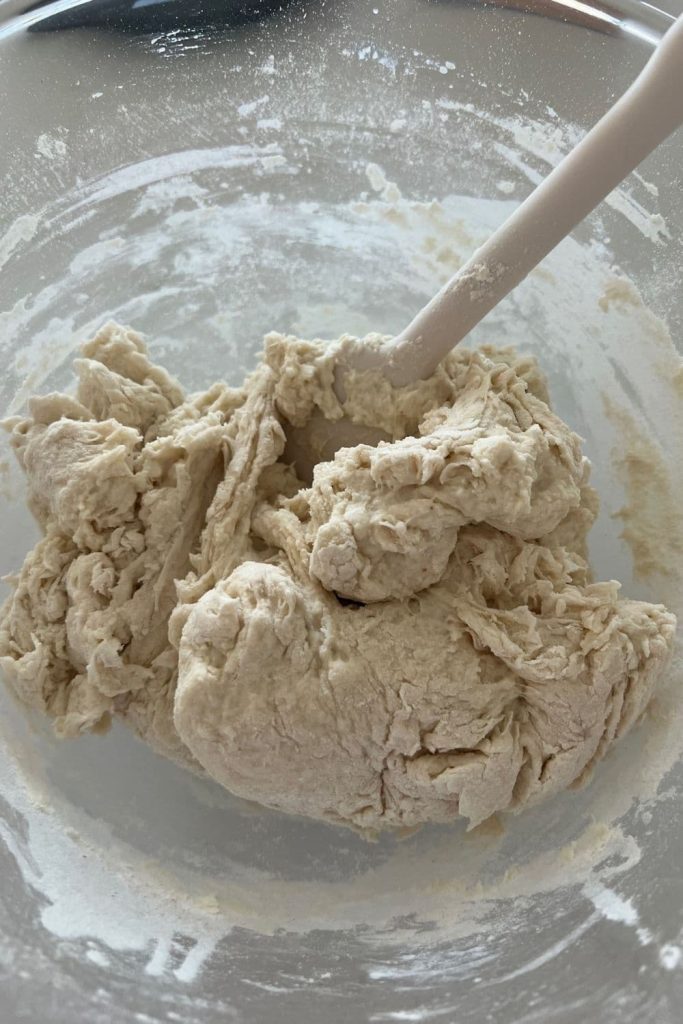
After the dough has been through fermentolyse you need to bring it together into a ball. Work your way around the bowl, grabbing the dough from the outside, stretching it up and over itself, into the centre, until a smoother dough ball is formed. Pop the cover back on and let the dough rest for 30 minutes.

Stretches & Folds
Over the next few hours you need to create some structure for your dough by “stretching and folding”. Aim to do around 4-6 sets of stretches and folds. For each set, stretch the dough up and over itself 4 times. Leave around 15 minutes in between each set. Again you do not have to be exact with time, but you need to do at least 4 sets over 2 hours.

Once you’ve finished your stretch and folds, cover the dough with plastic wrap or an elastic food cover and allow the dough to double at room temperature (bulk fermentation). Remember if your home is cold, it’s best to seek out a warm spot for your dough.

Shaping Sourdough Bread Bowls
Once your dough has finished its first ferment, it’s time to shape your sourdough bread bowls. I don’t use flour when shaping my sourdough, but if you want to use some flour, I recommend a little rice flour or semolina. Just remember you want a lightly floured work surface, so don’t be too heavy handed with the flour here!
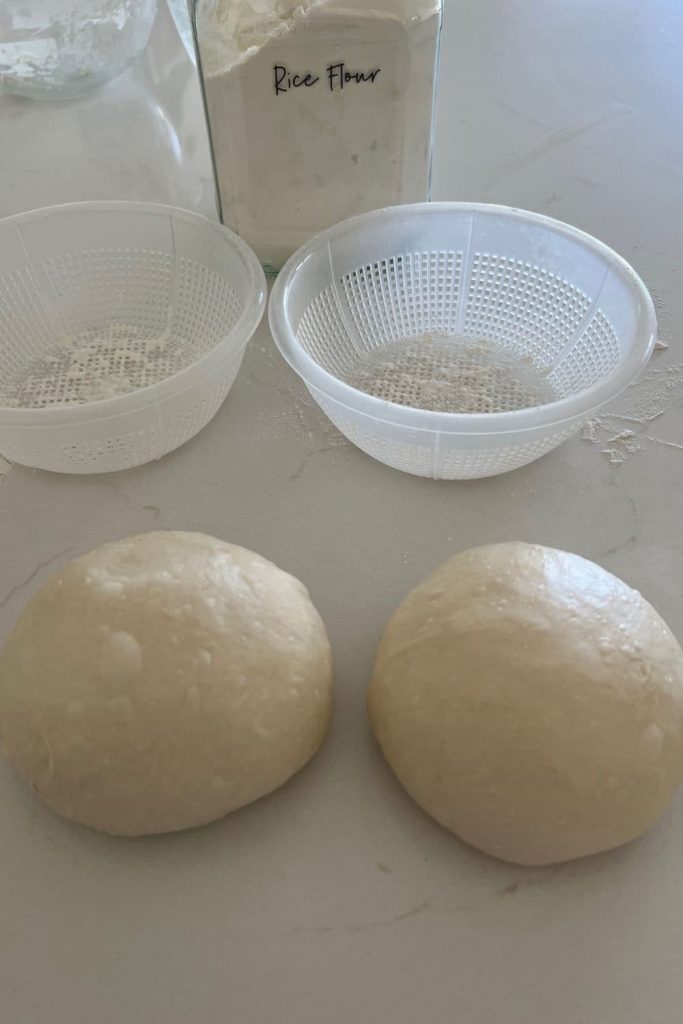
Ease the dough out of the bowl, so it lands upside down on your counter. The smooth top of the dough should be on the countertop and the sticky underside should be facing up. This will make it easier to shape. Divide the dough into two equal portions using a dough scraper (I weigh my dough to get them perfectly even, but you don’t have to if you don’t want to. Each piece of dough will be approx. 480 grams).
Take each piece of dough and bring the edges into the middle, forming a rough ball. Gently flip the dough over and then use the sticky side of the dough to tension it and form a perfect ball (it’s just like shaping a mini boule).
Placing Into A Proofing Container
Once the dough is shaped into a tight ball, place it into your proofing basket or container seam side up, stitching the base together if you need to. For this recipe, I’ve used two ricotta baskets and they worked really well – but you could use cereal bowls, small mixing bowls or whatever you have on hand. Cover the dough and place it into the fridge for the cold ferment.

There are lots of things you can use as a proofing basket for these smaller sourdough bread bowls. You just need to have a look around the kitchen to see what you have on hand:
- ricotta baskets (the ones I use are 6-inches/16cm)
- cereal bowls
- soup bowls
- small mixing bowls
If you are making these sourdough soup bowls more often, you might like to invest in a set of smaller banneton baskets. I recommend these 6″ banneton baskets.

Bake Your Sourdough Bread Bowls
You can bake these sourdough bread bowls a number of different ways. If you have a Dutch Oven large enough to bake two at time, that’s a great option. Otherwise, you can do an open bake on a large baking tray (depending on how many you are baking at time). I’ve added instructions for both methods below.
Bake Bread Bowls With A Dutch Oven
Carefully take your dutch oven out of the oven. Place the bread bowls into the pot using the silicone sling or parchment paper as a handle. Put the lid on and place into the hot oven.
BAKE TIME:
30 Minutes with the lid on at 230ºC/450ºF plus
10-15 Minutes with the lid off at 210ºC/410ºF
Bake Bread Bowls Without A Dutch Oven
One of the best ways to bake sourdough without a Dutch Oven is to use a baking stone. A baking stone or pizza stone is best use when preheated inside the oven when you turn the oven on. Alternatively, you can just bake your sourdough bread bowls on a baking sheet.
When your oven is at temperature, take your sourdough out of the fridge. Gently place your dough onto a bread peel. This makes it easy to transfer your sourdough bread bowls onto the hot baking stone inside your oven.

Gently score your bread with a clean razor blade or knife. It doesn’t have to be perfect as you’ll cut that piece off when you hollow out the loaves after baking. Place your dough into the oven.
BAKE TIME:
20 minutes at 230ºC/450ºF plus
25 to 30 minutes at 210ºC/410ºF
Carefully remove your sourdough bread bowls from the oven and place them on a wire rack to cool. Don’t attempt to hollow them out until they are completely cool or you’ll get a gummy centre, not to mention it’s so much harder to cut them when they’re hot!
Kate’s Pro Tip
Scoring Tip for Better Bread Bowls
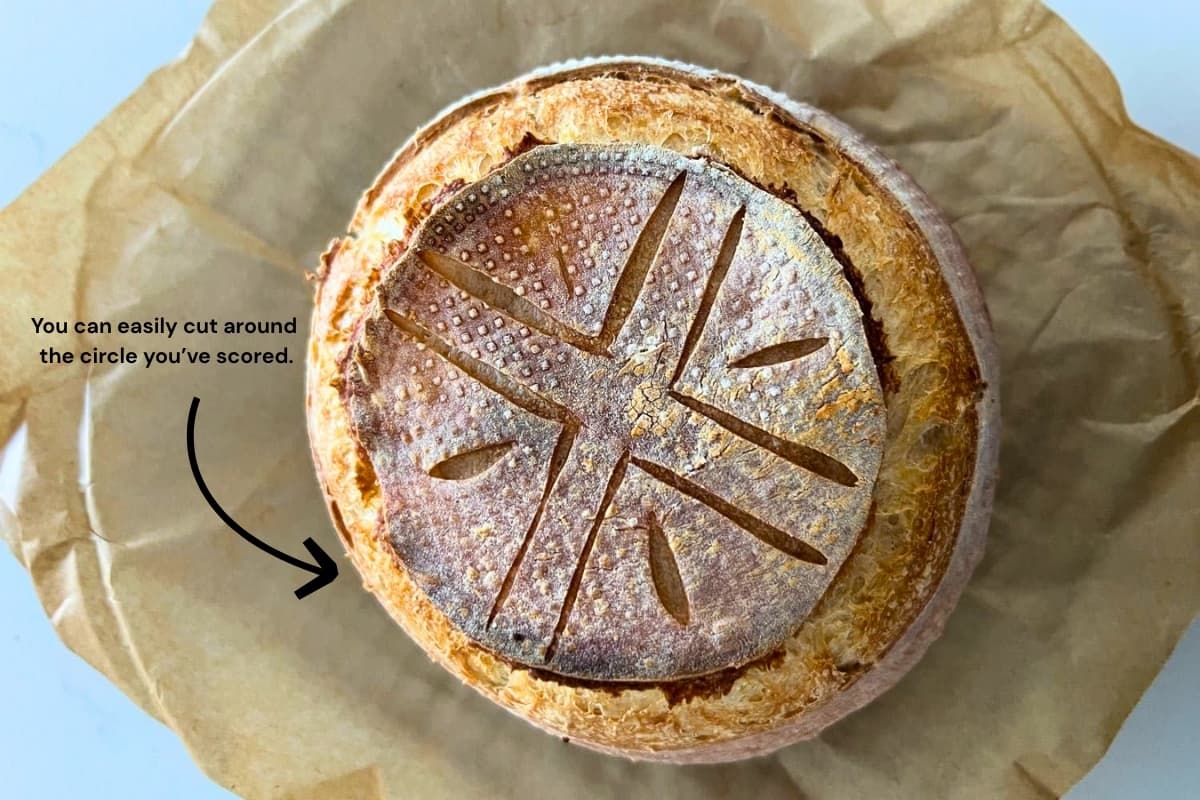
To make cutting the top of your sourdough bread bowls easier once they’re baked, use your lame or a sharp knife for score a circle around the top where you will cut the bread later. This makes it so much easier to use later!
Cutting The Sourdough Bread Bowls
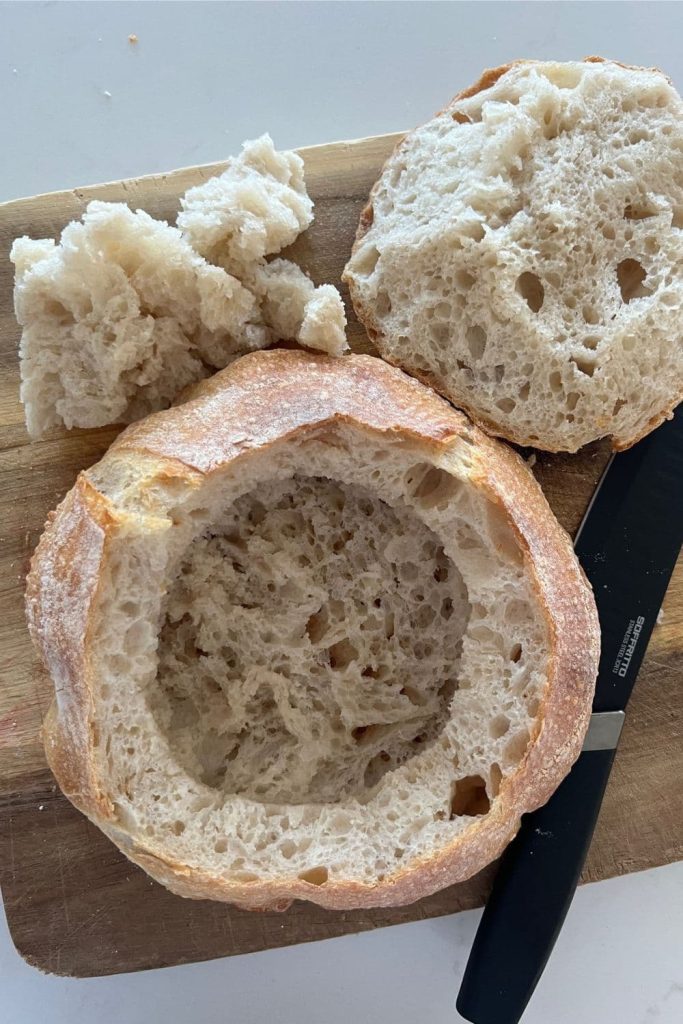
You’ll need a small, sharp knife to cut the top out of the sourdough bread. I find it easier not to use a serrated knife for this part. Once you’ve cut a neat circle, take the top off the loaf and set aside (this is great to dip into soup). Then use your fingers to hollow out the dough to form the “bowl”. You can toast the dough chunks to use as sourdough croutons!
What To Serve In Sourdough Soup Bowls
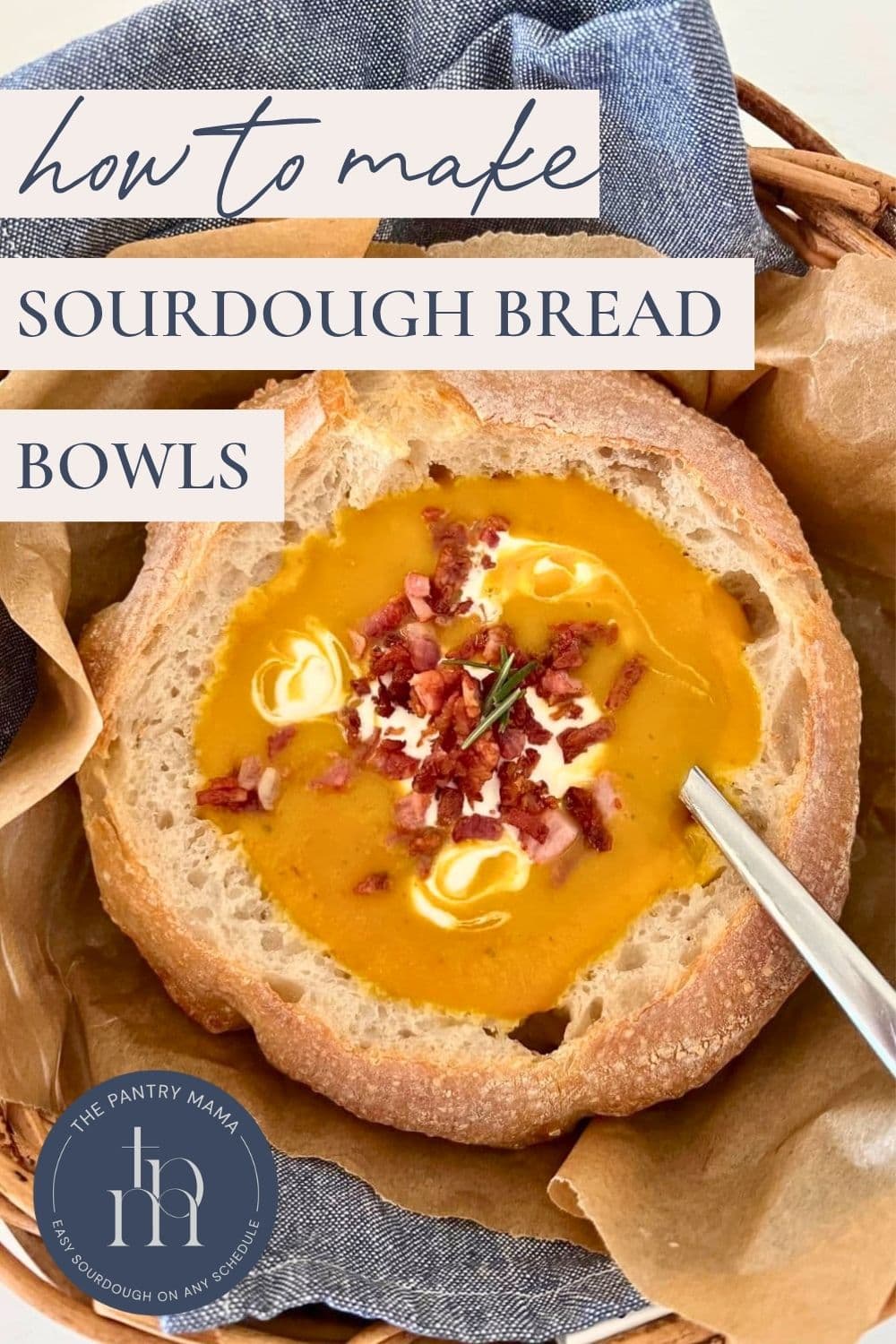
My family’s favorite soup is pumpkin – topped with lots of sour cream and crispy bacon. And it’s much more fun when you can eat the bowl too! Thicker soups work better than thinner soups in sourdough bread bowls. If the soup is too thin, it will leach into the bread too quickly and make it soggy. Some other ideas for soups and stews to serve in your sourdough bread bowls are:
- Clam chowder: This classic New England soup is a popular choice for serving in a bread bowl. The creamy, savory soup pairs perfectly with the crusty bread.
- Chili: Thick and hearty chili is another great option for a bread bowl. The bread absorbs the flavors of the chili and adds a nice texture contrast.Broccoli cheddar soup: This creamy soup with chunks of broccoli and melted cheddar cheese is a favorite for many. Serving it in a bread bowl makes it even more delicious.
- French onion soup: This soup, made with caramelized onions and topped with a layer of melted cheese, is a popular choice for serving in a bread bowl. The bread soaks up the savory broth and adds a satisfying crunch.
- Tomato soup: This classic soup is simple yet satisfying, and serving it in a bread bowl adds an extra dimension of flavor and texture.
- Spinach and artichoke dip: This creamy and cheesy dip is perfect for scooping up with bread, and serving it in a bread bowl takes it to the next level.
- Beef stew: Hearty and comforting beef stew is a great option for a bread bowl. The bread soaks up the flavorful broth and adds a nice crunch. We love this sourdough Irish beef and Guinness stew.
- Taco soup: This spicy soup made with ground beef, beans, and Mexican spices is a great choice for a bread bowl. The bread soaks up the flavors and adds a nice texture contrast.

Frequently Asked Questions
You can egg wash your sourdough bread bowls before baking if you wish, but it’s definitely not essential. Egg washing the bread bowls can make them burn more easily so you need to consider that before baking.
You don’t need to toast the inside of the sourdough bread bowl before adding the soup (although you can if you want to). Sourdough bread is strong enough to hold up the heartiest of soups (although I do recommend a thicker soup, rather than a thinner soup).
Absolutely! These sourdough bread bowls are perfect for holding your favorite dip! I love making two bread bowls and filling each with a different dip (warm spinach and artichoke and a three layer mexican are my faves). You can even bake a few extra bread bowls and slice them up to dip inside – yum!
Sourdough Bread Bowl Recipe
Equipment
- Basic Kitchen Scale
- Small Banneton Baskets
Ingredients
- 500 g Bread Flour
- 350 g Water
- 100 g Sourdough Starter
- 10 g Salt
Instructions
- BEFORE YOU STARTThis recipe is for 2 sourdough bread bowls. Depending on how comfortable you are in dividing dough after bulk fermentation, you could choose to make the whole batch as one dough, or divide it into two smaller bowls if you prefer – it's up to you!To make more than 2 sourdough bread bowls, simply multiply the recipe (ie for 4 bread bowls, double the recipe).
- Fermentolyse – Premixing The DoughWeigh out your sourdough starter and water into a large mixing bowl. Mix the water and starter together briefly. Then add your flour and salt and mix whole lot together to form a shaggy dough. Cover your bowl with an elastic foo cover and let it sit for around 1 hour. It's ok if it's a little bit longer, it's not going to matter too much.
- Forming Up The DoughAfter the dough has been through autolyse you need to bring it together into a ball. Work your way around the bowl, grabbing the dough from the outside, stretching it up and over itself, into the centre, until a smooth ball is formed. You shouldn't need more than about 20-25 stretches to form the ball. Once the dough has formed into a smooth ball, pop the cover back on and let it rest for 30 minutes.
- Stretch & Fold – Creating StructureOver the next few hours you need to create some structure for your dough by "stretching and folding". Aim to do around 4-6 sets of stretches and folds. For each set, stretch the dough up and over itself 4 times. Leave around 15 minutes in between each set. Again you do not have to be exact with time, but you need to do at least 4 sets over 2 hours.
- Bulk FermentOnce you've finished your stretch and folds, cover the dough with a plastic cover and allow the dough to double at room temperature.
- Shaping The DoughOnce your dough has finished its first ferment, it's time to shape your sourdough bread bowls. Use a dough scraper to gently ease the dough out of the bowl (your hands work just fine if you don't have one). You want it to land upside down on your counter so that the smooth top of the dough is on the countertop and the sticky underside is facing up. This will make it easier to shape.Divide the dough into two equal pieces using a dough scraper (I weigh my dough to get them perfectly even, but you don't have to if you don't want to. Each piece of dough will be approx. 480g).Take each piece of dough and bring the edges into the middle, forming a rough ball. Gently flip the dough over and then use the sticky side of the dough to tension it and form a perfect ball (it's just like shaping a mini boule).
- Placing Into A Proofing ContainerOnce the dough is shaped into a tight ball, place it into your proofing basket or container smooth side down, so your seam is on the top. Lift your dough around the edges to pop some rice flour if you feel it needs it. For this recipe, I used two ricotta baskets and they worked really well – but you could use cereal bowls, small mixing bowls or whatever you have on hand.
- Cold FermentNow the dough is in its "shaping container" cover it loosely with a plastic bag and place into the fridge. Try to leave it in the fridge for a minimum 5 hours up to a maximum of around 36 hours. The longer you leave it the better your bread will be!
BAKE YOUR SOURDOUGH BREAD BOWLS!
- Once you're ready to bake your sourdough, you'll need to preheat your oven to 230ºC/450ºF. When your oven is at temperature, take your sourdough out of the fridge. Gently place it onto a piece of parchment paper or silicone sling if using. Score your bread with a clean razor blade or knife.
- BAKE WITH DUTCH OVENCarefully take your dutch oven out of the oven. Place the sourdough into the pot using the silicone sling or parchment paper as a handle. Put the lid on and place into the hot oven. If you want to you can spritz your dough with extra water before you put the lid on.BAKE TIME:30 Minutes with the lid on at 230ºC/450ºF plus10-15 Minutes with the lid off at 210ºC/410ºF
- OPEN BAKE WITHOUT DUTCH OVENOnce you're ready to bake your sourdough, you'll need to preheat your oven to 230ºC/450ºF. Ensure that you have placed a baking stone in the oven if you are going to use one. For more information on baking without a Dutch Oven see here.When your oven is at temperature, take your sourdough out of the fridge. Gently place your dough onto a bread peel or into your preferred baking method (enamel roasting pan/pot, casserole dish, stainless steel pot etc).Gently score your bread with a clean razor blade or knife. At minimum a large cross is sufficient, but you can get as artistic as you like. You can find my full guide on how to score sourdough bread here.Place your dough into the oven.BAKE TIME:20 minutes at 230ºC/450ºF plus25 to 30 minutes at 210ºC/410ºF
- Carefully remove your sourdough bread bowls from the oven and allow them to cool completely before you try to hollow them out.
- Cutting The Bread BowlsYou'll need a small, sharp knife to cut the top out of the sourdough bread. I find it easier not to use a serrated knife for this part. Once you've cut a neat circle, take the top off the loaf and set aside (this is great to dip into soup). Then use your fingers to hollow out the dough to form the "bowl". You can toast the dough chunks to use as croutons!
Notes
Nutrition
Nutrition information is automatically calculated, so should only be used as an approximation.
Like this? Rate and comment below!










I think this will be the perfect recipe for our Christmas Eve soup bowls. Since I’ll be cutting out the centers, I should only need a small cut for steam to escape? May I make them ahead and freeze them? How should they be wrapped to keep a few weeks in the freezer? I need to make 25 bread bowls. Thank you.
Made these fairly early in my sourdough bread making journey and they turned out AMAZING. I split one bread bowl in half before proofing and this made 2 bowls at a perfect size for our kiddos. Thank you for the great step by step instructions! Definitely making these again very soon!
Can the bread bowls be frozen after the cold proofing?
I don’t recommend this – I prefer freezing after baking and cooling. You can see Kate’s tips for freezing sourdough bread here.
Do you have to use a specific size banneton for the bread bowl shape? Or will any boule banneton work? I am so excited to try these!
I overproofed the dough (just didn’t get around to baking when I should have) but these were still so delicious! I split the recipe into thirds, and next time will make 4 bowls. The loafs are much bigger than we need, especially when served with a hearty chowder.
I don’t have a steam option on my oven. And my dutch oven isn’t large enough for two loaves. What do you suggest? Thanks!
You can just open bake these on a cookie sheet or even a pizza stone if you have one. You can add some steam to your oven but it’s not essential.
Thank you for all of your tips and recipes, all has been very helpful. I just completed the bread bowl recipe, once in a DO, the other half in an older Al Dutch oven with a flatter lid, That came out flatter. Next will try the same plan baking on a pizza stone with a hot water in an old heated cast iron oven skillet for steam, and spritz the loaves at the end with water.
Literally my go-to for bowls and full loaves. Always results in awesome flavor, crumb, everything!
We love that! Thank you, Leah!
THIS + Costco clam chowder = absolute goodness. I also love the Disneyland bread bowls and this hits the spot.