
Travelling with sourdough starter is easier than you might think! Whether you’re flying across the country, heading overseas or packing up for a family road trip, there are a few simple ways to keep your sourdough starter happy and healthy while you’re away.
This post contains affiliate links. Please see our disclosure policy.
In this guide, I’ll walk you through everything you need to know about travelling with sourdough starter, including how to take it on a plane, the best ways to pack wet or dried starter, how to feed and store it while you’re away, and what to do when you arrive at your destination. Because sourdough should fit around your life, even when that life involves passports, plane tickets and a much-needed holiday! Your sourdough starter is definitely not the boss of you.
Table of Contents
- My experience travelling with sourdough starter
- Can You Take Sourdough Starter On A Plane?
- Preparing Your Starter For Travel
- Your Sourdough Starter Travel Timeline
- Travel With Starter That’s Already Peaked
- Tips for Travelling With Starter
- Travelling Internationally With Sourdough Starter
- Have A Back Up Plan
- Want To Hit Pause On Your Sourdough Starter?
- A few other things to consider
My experience travelling with sourdough starter

Over the past few years, I’ve travelled internationally from Australia to the United States 4 times. I’ve also travelled domestically within Australia and inside the United States. This has given me first hand insight into travelling with sourdough starter, especially taking sourdough starter on a plane. My best advice is you only need a tiny amount of starter so don’t pack large amounts when all you need is 10 to 20 grams, if that! Taking just tiny amounts, I’ve been able to successfully refresh my starter upon arrival at my destination, giving the me the flexibility to share liquid starter with friends and family, as well as bake with it.
Can You Take Sourdough Starter On A Plane?
With some careful planning, yes, you can take sourdough starter on a plane. When travelling in the US, you cannot take more than 3.4 fluid ounces of liquid into the plane cabin. Sourdough starter is considered a liquid, however you can dehydrate a portion if you need to.
Here is how I travelled with sourdough starter domestically within the United States. Both of these options can either be taken in the cabin, or placed in your checked baggage.
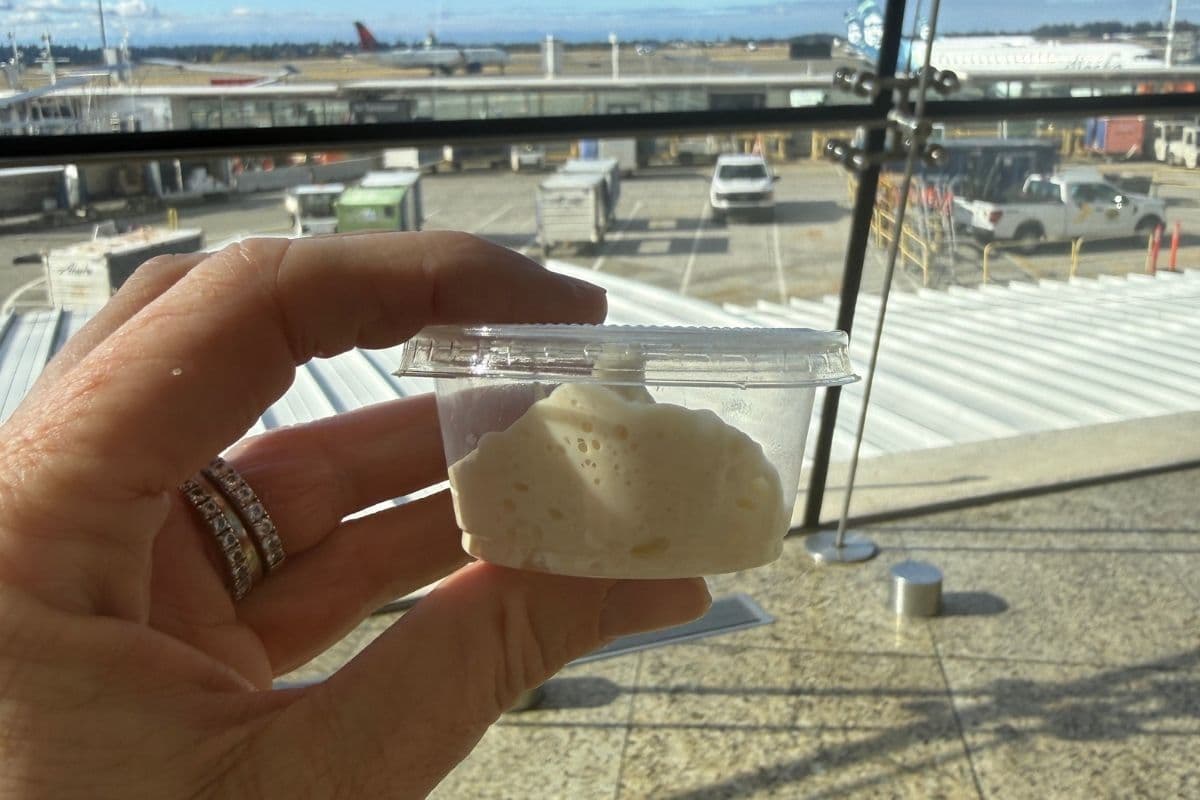
- Liquid Starter – A small amount (10 to 20 grams) of live sourdough starter placed into a 2 oz sauce container and then placed into a small ziplock bag. I recommend these small plastic condiment containers for packing your starter.
- Dehydrated Starter – Dry out a small amount of starter and place 20 to 30 grams in a small resealable packet. Honestly, you don’t even need that much, so you can pack less. Learn how to dehydrate sourdough starter.
Preparing Your Starter For Travel
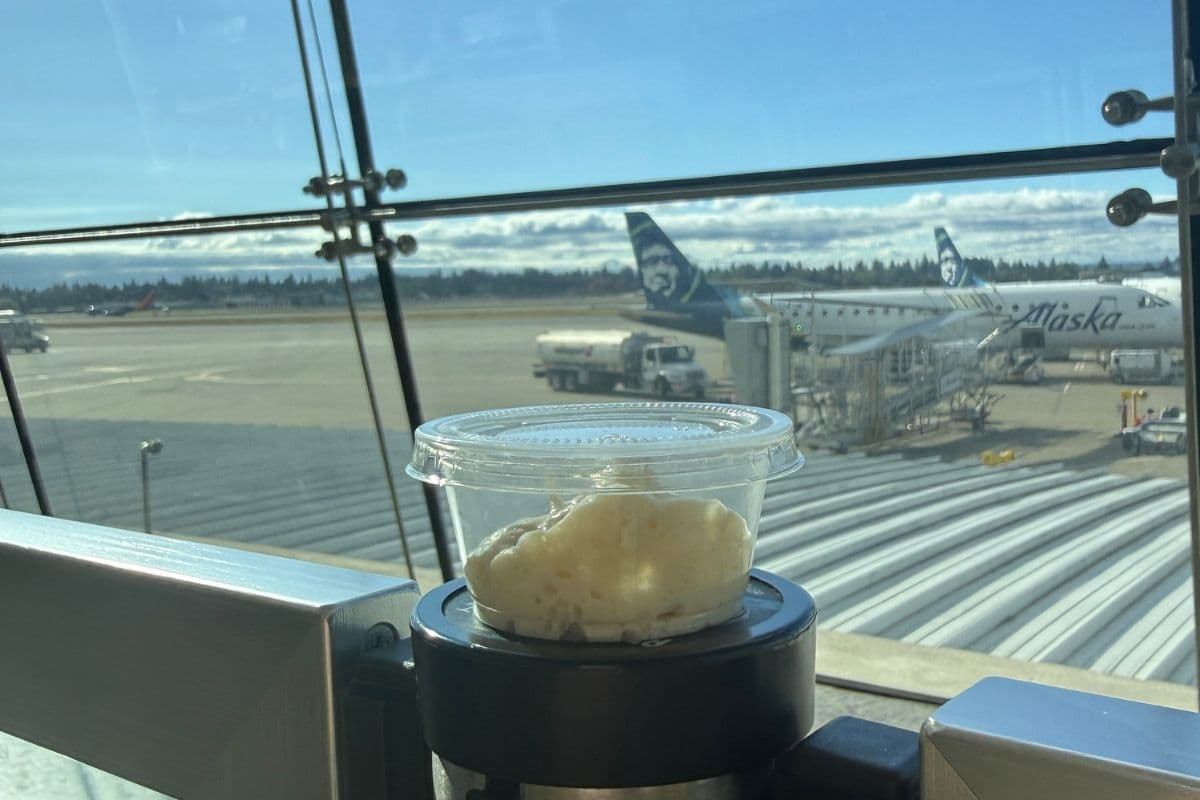
If you are going to travel with your sourdough starter, I recommend placing a small amount of sourdough starter into a 2 oz plastic container with a lid. If you’re travelling a long way, it can be better to use discard so you don’t risk the starter leaking and making a mess. This is why using a small amount of starter is important. You should use the smallest amount possible, so that even if the starter doubles inside the plastic container, it will not make a mess. So while I use a 2 oz container, I’m not actually filling the container completely.
Your Sourdough Starter Travel Timeline
- A few days before – Decide whether you’re travelling with wet or dried starter. Prepare dried backup if needed and check any travel restrictions.
- The night before – Prepare a small amount of liquid starter. If feeding it, allow room for expansion and plan the timing around departure. Ideally you want to feed the starter about 6 hours before you travel, if possible.
- On travel day – Pack your starter in a clean, leak-resistant container with plenty of headspace and secondary containment. Follow airport security rules.
- When you arrive – Check its condition. Feed it if you plan to bake, or refrigerate it if you’re not going to use it immediately.
- Before your first bake – Check that your starter is rising predictably and has returned to its usual activity.
Kate’s Pro Tip
Travel With Starter That’s Already Peaked
If you use freshly fed starter, the gas will build up inside the container as it peaks. Gas build up inside can pop the lid of the container which can cause a mess. So it’s always better to use starter that’s already peaked and always place the container in a plastic ziplock bag.
Tips for Travelling With Starter
- Less is More – Sourdough starter can be fed and increased easily, so travel with the least amount possible.
- Use Discard – If you’re worried about the starter doubling and leaking, use discard rather than recently fed starter. No matter what starter you pack, always place the container in a ziplock bag for added protection against leaks and mess.
- Digital Scale – If you’re planning to bake while you’re away, a small digital scale can be really helpful. I usually pack mine in my carry-on luggage because it contains batteries, although I’ve also removed the batteries and packed it in my checked baggage too. Make sure you check your airline’s rules for travelling with batteries.
- Flour – Have flour delivered to your destination if you need to feed your starter when you arrive.
- Hotel Room Feeding – If you’re going to be feeding your starter in a hotel room, remember to pack a spatula in your checked baggage.
Travelling Internationally With Sourdough Starter
If you’re planning to take your sourdough starter overseas, there are two things you need to consider: airport security rules and the customs and biosecurity regulations of the country you’re visiting.
While you may be able to take a small amount of liquid sourdough starter in your carry-on or checked luggage, this doesn’t necessarily mean you can bring it into another country.
Some countries have strict regulations about bringing food and agricultural products across their borders, and sourdough starter may be subject to these rules, even when it’s dehydrated.
Have A Back Up Plan
My advice is to always check the rules for your destination before you travel. Be prepared and have a back up plan if your starter is confiscated by airport security. A good option is to order a starter online and have it delivered to your hotel if you really need it when you get there.
Want To Hit Pause On Your Sourdough Starter?
If you’ve thought about travelling with your sourdough starter and decided it’s just not for you, you can put your sourdough starter on pause while you’re travelling. Putting your sourdough starter in the fridge will ensure that you’re able to come back to it when you’re home from your travels. Check out this guide to storing sourdough in the fridge. It includes how to prepare it for the fridge, as well as what to do when you come home!
A few other things to consider
I’ve travelled to the United States to take part in television segments where I’ve needed my sourdough starter to be bubbly and plentiful! In order to achieve this I ordered the things I needed to be delivered to my hotel when I get there. When I travelled to Dallas, I was able to find a Target close to my hotel where I was able to get everything I needed, including flour and jars. When I travelled to Seattle, I was able to order jars and flour on Amazon while I was on the plane. My equipment and flour arrived at my hotel before I did! This is a great idea if you’re not familiar with the shopping options at your destination.











Hello!
We are going to be hitting the road soon, traveling full time in an RV. Is there any risk to the starter from the jostling of the RV as we drive?
not at all – just keep it in a plastic container so it doesn’t crack.
Hello!
Would you know if Australian customs would allow for dehydrated sourdough starter to enter the country? I’m in North America and am thinking of mailing some as a gift for my friend in Oz.
Cheers
I’m honestly not sure. I have looked on the Border Force website but there is no definitive answer. It is not bread and not cooked so there isn’t clear guidelines. I also tried calling but could not get through the help line. You could look here to see the info I found 🙂 https://www.abf.gov.au/entering-and-leaving-australia/can-you-bring-it-in/categories/food#
Cheers for your help and for answering my question. I think I’ll take the chance to mail it out. Should it get chucked, c’est la vie! If it goes through, then my friend will have some of century old San Francisco starter to enjoy.
Hello! Would you know if Australian customs would allow for dehydrated starter to enter the country? I’m interested in mailing as a gift for a friend in Oz. I’m in North America.
Cheers
When I make the starter 12 hours before leaving for the airport, and set the lid on loosely, should it go in the fridge or leave it out on the counter?
Leave it on the counter with lid loose. Screw it on once it’s peaked and you want to take it with you 🙂 Safe travels xx
Hello, I’m flying tomorrow. Is there any reason I need to feed my starter first? It’s a strong starter and I bake with it from the fridge. Can I just put some in a container and feed it when I get to my destination?
Yes you can do this, if it’s mature, you can skip the feed 🙂 Safe travels xo
How do you know when it’s peaked? On the road there’s so many moves and the bubbles just fall down… how do I know it’s peaked are ready to be fed again?
Can’t use accurately my regular schedule because of temp chnages.
You should be able to see where the starter peaked by the sides of your jar, they should be smeared with sourdough starter, even if it’s fallen. You could make a stiff starter by adjusting your sourdough starter ratio. A stiff starter won’t lose gas as easily as a liquid starter will when you go over bumps 🙂
I’m going on a 5 day road trip. Do I need to keep my starter cold, in a cooler??
No you don’t need to keep it cold, long as you’re feeding it regularly it will be fine 🙂